03 · Behavior invisibility

Data Centers.

AI training loads are reshaping the grid at frequencies SCADA cannot resolve. The utility must serve the load that shows up, absorb the consequences, and explain costs it cannot yet measure.

data centers PJM ratepayers hyperscalers capacity market
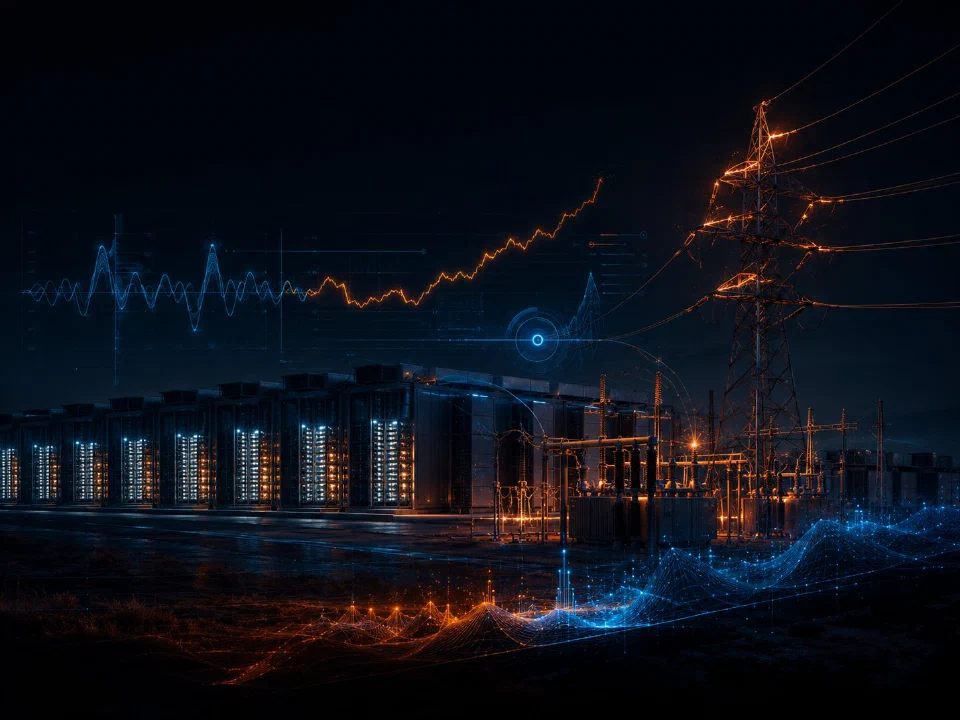
Hyperscale data center server racks adjacent to a high-voltage substation at night, with waveforms and a volatility arrow indicating grid impact
4.4%
of U.S. electricity consumed by data centers in 2023
LBNL / DOE · 2024
12%
projected share of U.S. electricity by 2028 (high estimate)
LBNL / DOE · 2024
$9.3B
in data-center-driven costs to PJM ratepayers in one year
IEEFA · Monitoring Analytics
A new kind of load

This is not a factory.

AI data centers do not draw power the way factories, office buildings, or even traditional data centers do. Large-scale GPU training synchronizes tens of thousands of processors, alternating between power-intensive computation and lower-power communication phases. The result is rhythmic power oscillations pulsing in the sub-synchronous frequency regime.

These oscillations can excite torsional resonance in turbine-generator shafts at power plants connected to the same transmission network. The result is physical destruction of generation equipment at a power plant miles from the data center that caused it.

What SCADA seesSCADA — 1 SAMPLE EVERY 2 SECONDS45 MW0s2s4s6s8s10s12s800 MS BETWEEN SAMPLESEXPANDED BELOWInside the gap between samplesCONTINUOUS MONITORINGSCADA AVG48 MW(COMPUTE)22 MW(COMMS)0 ms200 ms400 ms600 ms800 msSCADA samplesCompute load pulsesSCADA average

This is not a hypothetical. Northern Virginia hosts roughly 70% of America's data center capacity, all on Dominion Energy's transmission system. A Bloomberg analysis of approximately 770,000 residential power sensors found that Loudoun County experiences harmonic distortion at four times the national average.[1]

More than three-quarters of the worst power-quality readings nationwide are within 50 miles of major data center clusters, affecting an estimated 3.7 million Americans.[1]

The asymmetry

Utilities don't choose their customers.

A hyperscaler can relocate a project to a different state, a different grid operator, a different country. The utility has no such option. It must serve the load that shows up, absorb the grid impacts, justify the infrastructure costs to regulators, and answer to ratepayers when bills go up or power quality goes down.

The largest technology companies in the world are making siting decisions based on available power, tax incentives, and fiber connectivity. They are not selecting for grid health.

Data centers choose where to build. Utilities do not choose their customers.

Unprecedented scaling

AI broke the demand curve.

After two decades of nearly flat U.S. electricity demand, AI data centers have driven a surge in load growth at a pace the grid has not seen in generations.[2]

5,250MW
PJM demand forecast increase in a single auction
PJM · 2025
7years
interconnection queue wait for some projects
U.S. interconnection queue
2,600GW
proposed in the nationwide queue. More than 2x existing U.S. capacity.
LBNL · 2024

In PJM, the regional transmission organization serving 65 million people across 13 mid-Atlantic and Midwestern states, the demand forecast for the 2026–2027 capacity auction increased by 5,250 MW, almost entirely driven by data centers.[3]

Dominion Energy is receiving requests from individual data center campus developers for "several gigawatts" of power and has proposed its first base-rate increase since 1992.[4]

The visibility gap

Utilities are planning for the load. They are blind to its behavior.

The sub-synchronous oscillations produced by synchronized GPU workloads operate at timescales that SCADA systems cannot resolve. Utilities are planning for gigawatts of data center capacity but they are not measuring what this load is doing to the grid.

What harmonic distortion is this facility injecting into the substation?
Are its load swings exciting transmission oscillations at distant plants?
How fast are nearby transformers degrading under sustained harmonic stress?
Does power quality in the surrounding community still meet IEEE standards?
The cost

Five costs. One cause.

No one has published a comprehensive estimate of the total economic impact of AI data center load on the U.S. grid, in large part because the grid dynamics driving that impact are not being measured. The costs are real, distributed, and accelerating.

01

Residential damage and rate increases

$21/mo bill increase for D.C. Pepco customers, June 2025.[5]

Bloomberg estimates harmonic distortion from data centers threatens billions of dollars in damage to home appliances and electronics. 3.7 million Americans live in areas where distortion exceeds industry thresholds.[1]

02

Capacity market repricing

10x jump in PJM clearing price in two years. $21.3B in data-center-driven capacity costs over the last three auctions.[6]

PJM clearing prices rose from $28.92 per MW-day to $329.17 per MW-day for the 2026–2027 delivery year. The independent market monitor attributed 63% of the increase to data centers.[5]

03

Grid infrastructure buildout

$3.1T in grid investment needed before 2030. Dominion is planning 27 GW of new generation by 2039.[4]

Utilities across the country are filing for rate increases driven substantially by data center load growth. The costs flow to every ratepayer in the region.

04

Transformer and equipment degradation

2x faster transformer aging from a 10°C operating temperature rise.[7]

Sustained harmonic distortion accelerates insulation breakdown and overheats transformers. Equipment designed to last decades is operating under conditions it was never engineered for.

05

Public safety risk

Sustained power quality degradation increases vulnerability to voltage surges, electrical fires, and equipment failures.[8]

Grid reliability experts describe harmonics as a leading indicator of system stress. The downstream public safety costs of unmonitored grid degradation are unquantified but real.

You cannot price what you cannot see. You cannot manage what you do not measure.

The architectural answer

You cannot hold them accountable for what you cannot measure.

Every hyperscaler negotiation, rate case, interconnection study, and public explanation comes down to the same question: can the utility prove what the load is doing to the grid?

Data centers create fast electrical behavior at timescales SCADA was not built to capture: harmonic distortion, sub-synchronous oscillations, rapid power swings, and localized power-quality impacts.

PredictiveGrid captures that missing signal continuously. Residential-edge power quality, substation sub-second behavior, harmonic content at the point of common coupling, and time-aligned context across the footprint a hyperscaler is loading.

Now the utility has the evidence base to plan, negotiate, regulate, and explain what is happening.
The load showed up. The visibility didn't.

PingThings PredictiveGrid gives utilities the measurement layer this problem requires. Harmonic content at the point of common coupling. Sub-second substation behavior. Residential-edge power quality. The evidence base for every rate case, interconnection study, and hyperscaler negotiation.

References

  1. Bloomberg, "AI Needs So Much Power, It's Making Yours Worse," December 27, 2024. Analysis of approximately 770,000 Whisker Labs residential sensors and DC Byte data center market intelligence.
  2. Lawrence Berkeley National Laboratory, "2024 United States Data Center Energy Usage Report," December 2024. Funded by the DOE Industrial Efficiency and Decarbonization Office.
  3. PJM Interconnection, "2026/2027 Base Residual Auction Report," July 22, 2025; IEEFA, "Projected data center growth spurs PJM capacity prices by factor of 10," July 2025.
  4. Dominion Energy regulatory filings; Utility Dive reporting.
  5. IEEFA analysis; Monitoring Analytics (PJM Independent Market Monitor), January 2026; Pepco residential rate data.
  6. Utility Dive, "Data centers were 40% of PJM capacity costs in last auction: market monitor," January 7, 2026.
  7. ABB technical materials; IEEE thermal aging standards for transformers.
  8. Industry expert commentary on harmonic distortion as a leading indicator of grid stress, Bloomberg, December 2024.