A single steam turbine's 0.25 Hz oscillation interacted with a natural mode of the entire Eastern Interconnection and propagated across the grid for 18 minutes before the plant operator manually removed the unit from service.
—
IBR share
Solar, wind, and battery storage are destabilizing grids at frequencies SCADA cannot resolve. The inverter fleet is already doing it. A European grid collapsed in ninety seconds.
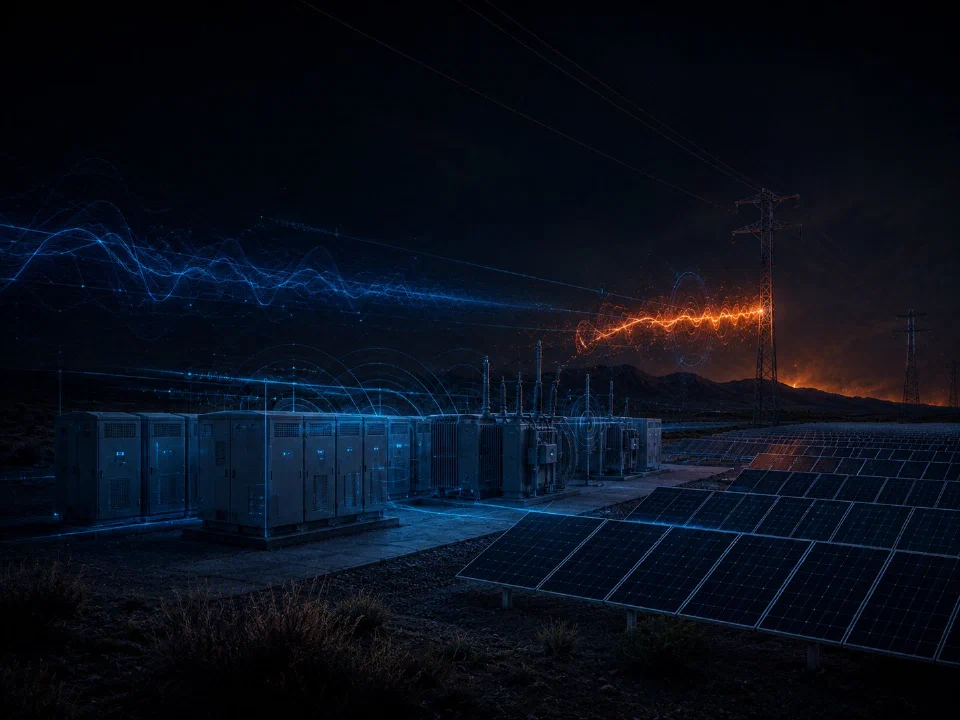
On April 28, 2025, the power grids of Spain and Portugal collapsed, cutting electricity to over 50 million people for up to 16 hours. The ENTSO-E final report confirmed the cause: cascading IBR oscillations and inverter-based generators that withdrew from the grid instead of stabilizing it.[1]
The traditional grid was built on synchronous generators, massive rotating machines that inherently stabilize frequency and voltage through physical inertia. As IBRs replace these machines, that stabilizing mass disappears.
IBRs connect to the grid through power electronics running complex control loops. These control loops interact with each other and with grid dynamics in ways that produce sub-synchronous oscillations: rapid power and voltage fluctuations at frequencies below the fundamental 60 Hz that the grid was designed around. When enough IBRs cluster in a region, their interactions can amplify oscillations to destructive levels.
Think of it as acoustic feedback in a stadium PA system: each speaker is working correctly, but their interactions produce a screech that no individual speaker intended.
This is not a deficiency in any single inverter. It is an emergent property of a grid whose physics are changing faster than its monitoring infrastructure. The oscillations are real. They are growing. At SCADA's 2 to 4 second scan rates, they are completely invisible.
These oscillations also do not arrive as discrete events. They wax and wane with load, weather, generation mix, and the control interactions of hundreds of inverters across the grid. Some persist for months at low amplitude before crossing into instability. Treating each as a moment to be detected misses the underlying behavior the utility actually needs to understand.
The Iberian blackout was not a one-off. Each event below reveals the same systemic vulnerabilities on the North American grid.[3]
The pattern is consistent: as the share of generation supplied by IBRs increases, the consequences of each disturbance grow. The events in California and Texas occurred when IBRs were supplying 33 to 61% of regional demand. Those shares are rising every year.
FERC waited fourteen years to establish mandatory reliability standards for a known, potentially catastrophic risk.
Every one of these events involved oscillations that SCADA could not see.
The oscillations that collapsed the Iberian grid operated at 0.2 Hz and 0.63 Hz. The disturbances in California and Texas were driven by inverter control interactions at sub-second timescales. SCADA polls every 2 to 4 seconds. The grid is adding IBRs faster than it is adding the ability to see what they are doing.
Battery energy storage carries the same oscillation, tripping, and ride-through risks as solar and wind. The problem is not slowing down. It is accelerating.
The nationwide interconnection queue contains over 2,600 GW of proposed generation, roughly twice the entire existing U.S. generating capacity of approximately 1,300 GW. Solar, battery, and wind comprise over 95%.[4]
Every one of these resources connects through inverters. NERC's 2022 BESS disturbance report made clear that batteries carry the same oscillation, tripping, and ride-through risks as solar and wind.[5]
PredictiveGrid helps utilities understand what their IBR fleets are actually doing. Not just whether an alarm should fire.
Most IBR monitoring watches the last few seconds of grid behavior. But oscillations are not discrete events. They are continuous dynamics that rise, fade, shift, and return as load, weather, generation mix, and inverter controls interact across hundreds of devices.
Root cause requires history: months of full-resolution synchrophasor data, time-aligned across substations and assets, queryable fast enough to compare today's instability against past behavior.
That is the foundation PredictiveGrid provides. Without it, mitigation is a bandaid on a symptom the utility never fully understood.
Detection tells you an oscillation is happening. It does not tell you why.
PingThings PredictiveGrid captures and time-aligns full-resolution synchrophasor data across substations and assets. Months of history, queryable in milliseconds. The foundation for understanding what your IBR fleet is actually doing.