Wildfire Ignition.
When the utility's equipment starts the fire, the data is the defense. Most utilities cannot collect it because the events that start fires happen between SCADA scans.
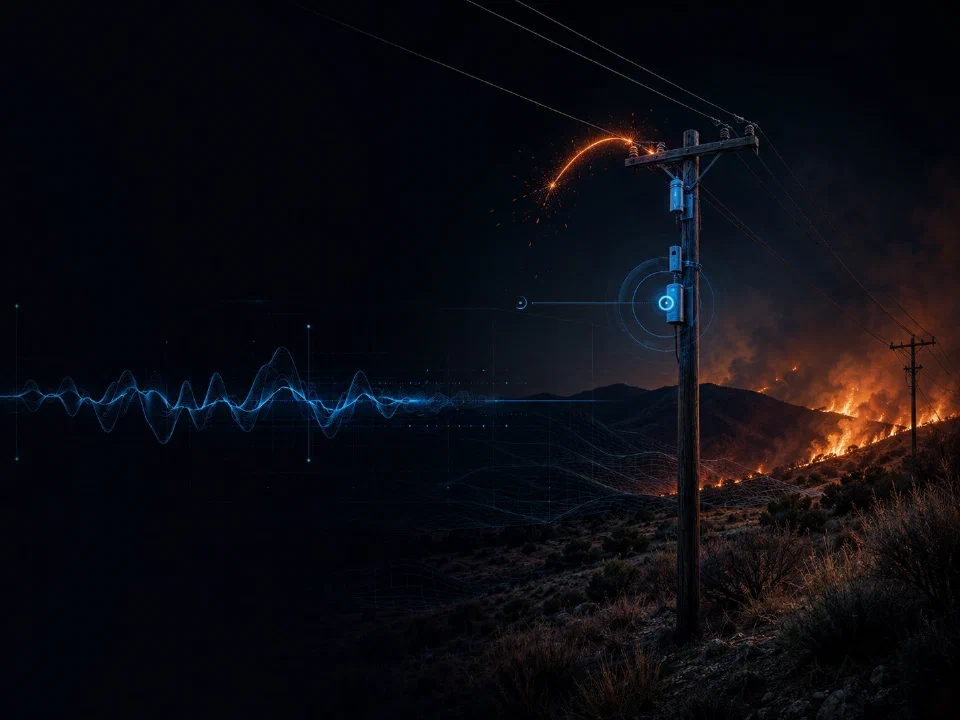
Bankrupting monopolies. Wildfires are the largest liabilities in utility history.
In January 2024, a contractor inspecting Xcel Energy's distribution poles in the Texas Panhandle flagged one as decayed and gave it a "priority one replacement" designation. Three weeks later, the pole snapped, dropped an energized line into dry grass, and ignited the Smokehouse Creek Fire, which became the largest wildfire in Texas history and burned over one million acres.[1] The fire was entirely preventable. It is also not an outlier.
Utilities have turned to blunt force.
Unable to monitor their systems in real time, utilities are deliberately de-energizing entire regions during high fire-risk weather. Public Safety Power Shutoffs began in California; the practice has now spread to at least four states.
A Boulder Chamber survey found that businesses averaged $25,000 in losses during a single December 2025 shutoff, with nine businesses reporting losses exceeding $100,000.[8]
A PSPS is not a solution. It is an admission that the utility cannot see what is happening on its own grid.
Undergrounding isn't the answer.
Utilities are spending billions on new infrastructure to address what is actually a visibility problem.
PG&E is burying 10,000 miles of power lines at $3 to $4 million per mile. Utilities are deploying AI-equipped cameras, expanding weather station networks, and installing new pole-mounted sensors. PG&E's wildfire mitigation plan alone could cost $2.3 billion, with ratepayers absorbing much of it.
Meanwhile, the grid already contains an enormous installed base of sensing capability that goes largely unused. Phasor measurement units have been deployed at over 2,500 locations across the nation's bulk power systems.[9] Thousands more digital fault recorders, power quality monitors, relay event loggers, and point-on-wave recorders are embedded throughout utility infrastructure.
In most utility deployments, a vast percentage of these devices are dormant or collecting data that is never retrieved, creating an enormous legal liability. The problem is not a lack of sensors. Utilities just cannot see what the grid is telling them.
Ignition happens between scans.
Wildfire ignition precursors are fast: vegetation contact, conductor failure, arcing, and cross-phase faults can unfold in milliseconds. SCADA scans every two to four seconds. The signal exists. SCADA never sees it.
| Phenomenon | Timescale | Visible to SCADA? |
|---|---|---|
| IBR oscillations | Milliseconds | No. Invisible at 2–4 second scan rates. |
| Arcing & incipient faults | Sub-cycle | No. Appears as noise or is undetected. |
| Harmonic distortion | Continuous | No. Requires waveform-level capture. |
| Sub-cycle transients | Microseconds | No. Occurs between SCADA polls. |
A conductor can arc, ignite vegetation, and start a fire entirely between scans.
The sensors exist. Utilities aren't collecting the data.
Utilities already own sensors that can see these events: PMUs, DFRs, relays, power quality meters, and waveform recorders. But many are underused, turned off, or disconnected because the utility lacks the infrastructure to collect, retain, align, and query the data.
PredictiveGrid closes the visibility gap. It activates the existing installed base, capturing high-resolution waveform and synchrophasor data from sensors utilities have already paid for, time-aligning across substations and asset classes, and serving any moment in fire season queryable in milliseconds.
That same data supports both prevention and defense: early precursor detection before an event, and forensic-grade evidence of what the grid was doing in the seconds before a fault.
The same data that prevents an ignition also defends the utility when one happens.
The sensors already exist. Now activate them.
PingThings PredictiveGrid turns the dormant sensors utilities have already deployed into queryable, contextualized visibility. Forensic-grade evidence on every fault. Prevention before the next ignition.
References
- Texas Attorney General lawsuit vs. Xcel Energy, Dec. 2025; Utility Dive, Dec. 22, 2025.
- Wikipedia, "Camp Fire (2018)"; CNBC, Jan. 7, 2019.
- NPR, Jun. 16, 2020.
- Wall Street Journal investigation, Jan. 2019; Fox Business, Jul. 20, 2021.
- Colorado Newsline, Sep. 25, 2025; Xcel Energy Newsroom, Sep. 24, 2025.
- Reuters, Feb. 13, 2025; SCE quarterly regulatory filing.
- Verisk Extreme Event Solutions, Jan. 22, 2025.
- Denver7, Jan. 16, 2026; Boulder Chamber survey of approximately 300 businesses.
- U.S. Department of Energy, Office of Electricity, Big Data Synchrophasor Analysis.